Translate

Tuesday, March 11, 2014

Holy, Holy, Holy


Two prophets--one from the Old Testament, and one from the New;
both chosen while alive to see that which most of us will only see after death

Both the great prophet, Isaiah, and the Apostle John, capture the reality in the same words.

Isaiah 6:3

3And one called to another and said: “Holy, holy, holy is the Lord of hosts; the whole earth is full of his glory.”

Revelation 4:8

8And the four living creatures, each of them with six wings, are full of eyes all around and inside. Day and night without ceasing they sing, “Holy, holy, holy, the Lord God the Almighty, who was and is and is to come.”

Jesus had this to say about Isaiah's testimony:

John 12:41

41Isaiah said this because he saw his glory and spoke about him.

Good to keep in mind as we contemplate for the 99.999999% of us still living who do not get whisked into the the holiness of the reality of God's holiness and glory, charged to give an account to foster the faith, love, trust, and hope of the rest of us!

Let us pray the prayer taught by the angel to the children at Fatima:
PARDON PRAYER
MY GOD, I believe, I adore, I trust, and I love Thee! 
I ask pardon for for those who do not believe, 
do not adore, do not trust and do not love Thee.

Let us take encouragement from these words of our beloved Lord, Jesus the Son of God:

John 20:29

29Jesus said to him, ‘Have you believed because you have seen me? Blessed are those who have not seen and yet have come to believe.’

Sunday, March 9, 2014

Thank You, Mom

"Thank you, Mom, for giving birth to me.

Thank you, Mom, for feeding me every night.

Thank you, Mom, for telling me about Jesus."

This is what my son told me after eating his fill of Ukrainian pierogies, and two slices of honey bun cake.  I've noticed the males in this family are happiest and most loving after eating well.

Still, had to post this because these three thank you's need the platform of the world wide web.

A good Sunday to you all!

God Bless You!

Friday, February 28, 2014

Can't Always Get What You Want

But if you believe in God, trust in him, and wait upon him and his will to be accomplished, you will!

Revelation 21

21Then I saw a new heaven and a new earth; for the first heaven and the first earth had passed away, and the sea was no more.2And I saw the holy city, the new Jerusalem, coming down out of heaven from God, prepared as a bride adorned for her husband. 3And I heard a loud voice from the throne saying,
‘See, the home* of God is among mortals.
He will dwell* with them;
they will be his peoples,*
and God himself will be with them;*
4 he will wipe every tear from their eyes.
Death will be no more;
mourning and crying and pain will be no more,
for the first things have passed away.’
5 And the one who was seated on the throne said, ‘See, I am making all things new.’ Also he said, ‘Write this, for these words are trustworthy and true.’ 6Then he said to me, ‘It is done! I am the Alpha and the Omega, the beginning and the end. To the thirsty I will give water as a gift from the spring of the water of life. 

This has to be one of the most wonderful, hopeful passages in the whole Bible.  I guess this is a "Sunday" reading for a "Friday" when we should remember the price Jesus paid, the gift the Father made to give us this blessed hope.  A few times in recent days I've hoped for something that would have at best given us a little temporal, fleeting happiness.  I still prayed that God's will be done, and the fact that the Holy Spirit stuck that little prayer in my head helped me to accept the disappointment even when it was at its sharpest.  

Just as I tell the girls I coach in basketball, and as Larry Bird once said, "You learn more from a defeat than a victory."  

I do trust the God who left this little jewel for us:

Romans 8:28

We know that all things work together for good* for those who love God, who are called according to his purpose.


Not the good now, in the timing that my little brain desires, but the good that is the building of Christ-like virtue in us and those around us.

Thank you for the reminder and the gift of faith that comes from reading the opening of Revelation 21. You are the Alpha and the Omega. You are making all things new. You are bringing us into your kingdom where you will wipe away all tears.
I believe the disappointment was for the good of those involved. Thank you God for the peace and hope you give me in presenting that little phrase in the Lord's Prayer - "Your will be done," and the next, "Your Kingdom Come."

Revelation 22

22 I saw no temple in the city, for its temple is the Lord God the Almighty and the Lamb. 23And the city has no need of sun or moon to shine on it, for the glory of God is its light, and its lamp is the Lamb.

Revelation 23

3Nothing accursed will be found there any more. But the throne of God and of the Lamb will be in it, and his servants* will worship him; 4they will see his face, and his name will be on their foreheads. 5And there will be no more night; they need no light of lamp or sun, for the Lord God will be their light, and they will reign for ever and ever.
6 And he said to me, ‘These words are trustworthy and true, for the Lord, the God of the spirits of the prophets, has sent his angel to show his servants* what must soon take place.’
7 ‘See, I am coming soon! Blessed is the one who keeps the words of the prophecy of this book.’ 

Blessed are we to have this hope.  Blessed are we to put trust in the Lord.  We will get what we want - to worship him, bathed in the light of his glory, seeing his face, forever!

Tuesday, February 11, 2014

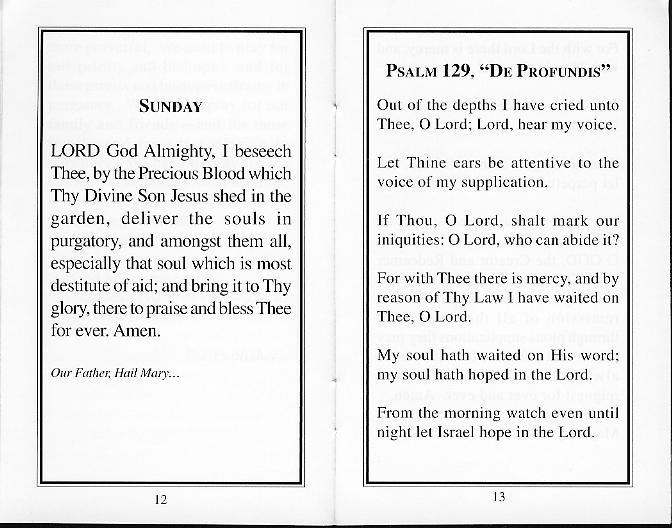
De Profundis

The De Profundis takes its name from the first two words of the psalm in Latin. It is a penitential psalm that is sung as part of vespers (evening prayer) and in commemorations of the dead. It is also a good psalm to express our sorrow as we prepare for the Sacrament of Confession.
Every time you recite the De Profundis, you can receive a partial indulgence (the remission of a portion of punishment for sin). 
Out of the depths I cry to You, O Lord; Lord, hear my voice.  Let Your ears be attentive to my voice in supplication.  If You, O Lord, mark iniquities, Lord, who can stand?  But with You is forgiveness, that You may be revered.I trust in the Lord; my soul trusts in His word.  My soul waits for the Lord more than sentinels wait for the dawn.  More than sentinels wait for the dawn, let Israel wait for the Lord.  For with the Lord is kindness and with Him is plenteous redemption; And He will redeem Israel from all their iniquities.

From the source:

Psalm 130

A Song of Ascents.
1 Out of the depths I cry to you, O Lord. 
2   Lord, hear my voice!
Let your ears be attentive
   to the voice of my supplications! 

3 If you, O Lord, should mark iniquities,
   Lord, who could stand? 
4 But there is forgiveness with you,
   so that you may be revered. 

5 I wait for the Lord, my soul waits,
   and in his word I hope; 
6 my soul waits for the Lord
   more than those who watch for the morning,
   more than those who watch for the morning. 

7 O Israel, hope in the Lord!
   For with the Lord there is steadfast love,
   and with him is great power to redeem. 
8 It is he who will redeem Israel
   from all its iniquities.

Mary of Egypt left a life of sin and lived a life of repentance.  Here is synopsis of her life from a book I am enjoying, The Cloister Walk by Kathleen Norris 

Mary of Egypt lived in the fifth century, but her story is all too familiar in the twentieth. Running away from home at the age of twelve, she became a prostitute in Alexandria. At the age of twenty-nine, she grew curious about Jerusalem and joined a boatload of pilgrims by offering the crew her sexual services for the duration of the journey. She continued to work as a prostitute in Jerusalem. On hearing that a relic of the true cross was to be displayed at the Church of the Holy Sepulchre, her curiosity was aroused again, and she joined the feast-day crowds. But at the threshold of the church some invisible force held her back. Suddenly ashamed of the life she’d led, she began to weep. Kneeling before an icon of the Virgin Mary, she begged forgiveness and asked for help. A voice said to her, “If you cross over the Jordan, you will find rest.” Mary spent the rest of her life, forty-seven years, as a hermit in the desert. Late in her life, Mary encounters a monk who had come to the desert for a period of fasting, and she tells him her story. . . . The monk is amazed to discover that Mary knows many Bible verses by heart, for in the desert she has had no one but God to teach her. She asks him to bring communion to her, when next he comes to the desert, and this he does. On his third visit, however, he finds that Mary has died. . . . 

Monks have always told the story of Mary of Egypt to remind themselves not to grow complacent in their monastic observances, mistaking them for the salvation that comes from God alone. And in the Eastern Orthodox churches, Mary’s life is read on the Fifth Sunday of Lent, presented, as the scholar Benedicta Ward tells us, “as an icon in words of the theological truths about repentance.” . . . . Repentance is not a popular word these days, but I believe that any of us recognize it when it strikes us in the gut. Repentance is coming to our senses, seeing, suddenly, what we’ve done that we might not have done, or recognizing, as Oscar Wilde says in his great religious meditation De Profundis, that the problem is not in what we do but in what we become. Repentance is valuable because it opens in us the idea of change. I’ve known several young women who’ve worked in the sex trade, and one of the worst problems they encounter is the sense that change isn’t possible. They’re in a business that will discard them as useless once they’re past thirty, but they come to feel that this work is all they can do. Many, in fact, do not like what they become. 
The story of Mary of Egypt opens the floodgates of change. It comes from a tradition of desert stories suggesting that if monks and whores can’t talk to each other, who can? The monk who encounters Mary still has a lot to learn; his understanding of the spiritual life is facile in comparison to hers, and he knows it. Mary, for all her trials, is like one of those fortunate souls in the gospels to whom Jesus says , “Your faith has made you whole.” Benedicta Ward has said that these stories are about deliverance from “despair of the soul, from the risk of the tragedy of refusing life, of calling death life,” which may be one function of the slang term for prostitution: it is called “the life.” But the story of Mary of Egypt is one any of us might turn to when we’re frozen up inside, when we’re in need of remorse, in need of the tears that will melt what Ward terms “the ultimate block within [us]; that deep and cold conviction that [we] cannot love or be loved.” In this tradition, Ward says, virginity, defined as being whole, at one in oneself, and with God, can be restored by tears.
Norris, Kathleen (1997-04-01). The Cloister Walk (pp. 164-166). Penguin Group US. Kindle Edition.